A noisy bike chain is most often dry or dirty, but the same complaint can also mean a worn chain, a stiff or damaged link, a derailleur that needs indexing, cross-chaining at an extreme angle, or a component behind the chain that only sounds like the chain. Diagnose before you lubricate: identify when the noise happens, match the sound to a cause, and work through the checks in order rather than treating every sound with more lube.
In this guide
- Identify when the noise happens
- Match the sound to the cause
- Noise in specific gears
- A step-by-step diagnostic order
- How to fix each cause
- When it is not the chain
- When to see a mechanic
Identify when the noise happens
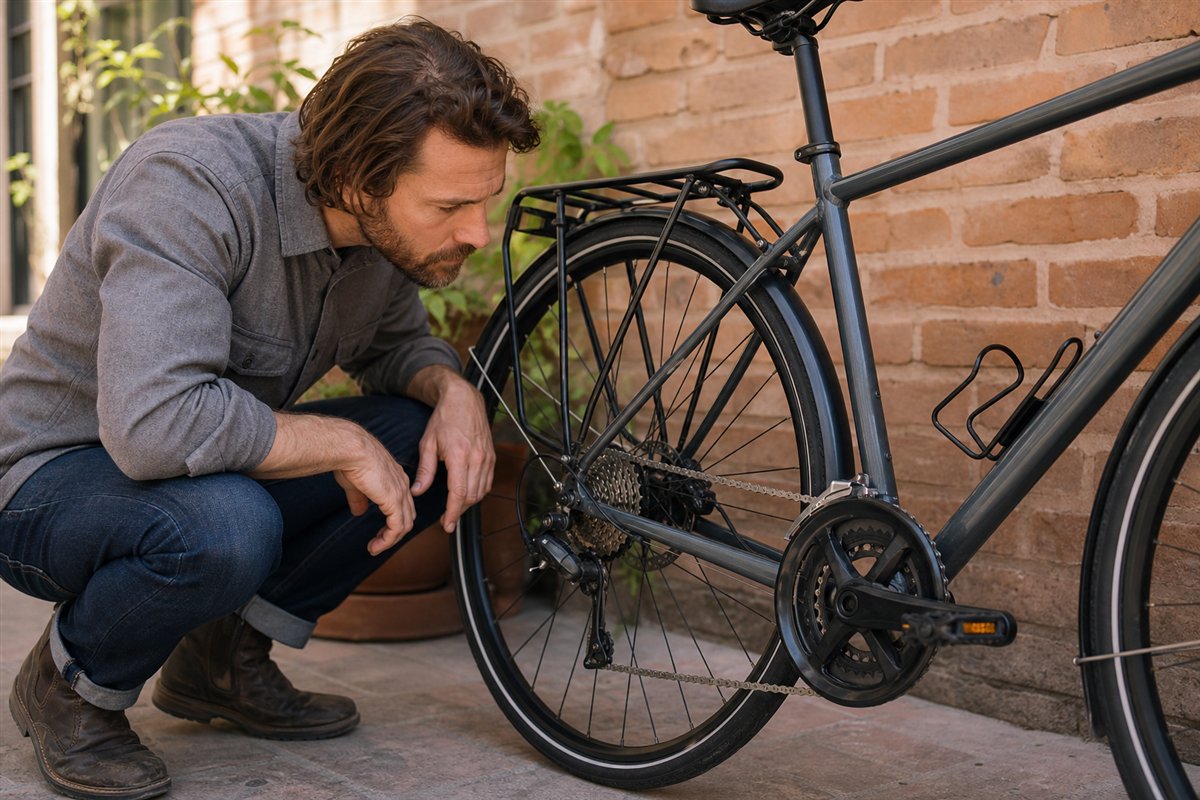
Before you touch a tool, listen. When a bike chain makes noise narrows the cause far faster than the sound alone. Put the bike in a stand or lift the rear wheel, turn the cranks slowly, and pay attention to the timing and the conditions that trigger the noise.
There are four questions worth answering first.
Does it happen every pedal stroke, or once per crank revolution? A noise tied to your pedaling effort, present in every gear, usually follows the chain itself: a dry or dirty chain, or a worn one. A distinct click or clunk that repeats once per full crank revolution, at the same point each time, points to a single item passing through the system, most often one stiff or damaged link, or sometimes a pedal or crank component.
Does it appear only in certain gears? Noise that comes and goes as you shift is an alignment story, not a lubrication story. It usually means the derailleur indexing is slightly off, the chain is cross-chained, or one sprocket is worn. A chain in good condition and correct adjustment should run near-silently across most of the cassette.
Does it happen while coasting, when you are not pedaling? A ticking or clicking that continues as the rear wheel spins with no pedal input is usually not the chain at all. The freehub makes a buzzing ratchet sound by design, but a rhythmic tick while coasting can be a wheel, tire, or brake issue.
Does it happen only when braking, standing, or under hard load? Noise that appears when you stand and push hard, or only under high torque, often comes from the bottom bracket, pedals, or seatpost rather than the chain, even though the sound seems to come from the same area. Load-related skipping, where the chain jumps forward under power, is a wear symptom covered in chain skipping under load.
Two more conditions are worth noting. Noise that only shows up after rain, or after a wet and muddy ride, almost always means the lubricant has been washed out and grit has taken its place; it will return every wet ride until you adopt a wet-weather lube and a post-ride wipe. And noise that has slowly grown louder over hundreds of miles, rather than appearing suddenly, is the signature of gradual chain wear rather than a discrete fault. Sudden noises point to a specific event (a link, a knocked derailleur, a dropped chain); gradual noises point to condition and wear.
| When the noise happens | Most likely source | First thing to check |
|---|---|---|
| Every pedal stroke, all gears | Dry, dirty, or worn chain | Wipe, inspect, and re-lube; then measure wear |
| Once per crank revolution, same spot | One stiff or damaged link (or a pedal/crank part) | Flex each link; inspect for a bent plate or tight pin |
| Only in one or two gears | Indexing off, worn sprocket, or cross-chaining | Fine-tune the barrel adjuster; avoid extreme angles |
| Across a run of gears, then quiets | Derailleur alignment or rub | Check front derailleur cage and pulley alignment |
| While coasting, no pedaling | Not the chain: wheel, hub, tire, or brake | Spin each wheel and listen; check pad clearance |
| Only standing or under hard load | Bottom bracket, pedals, or seatpost | Locate by isolation, not by lubricating the chain |
Match the sound to the cause
Once you know when the noise occurs, the character of the sound refines the diagnosis. People describe chain noise in three broad ways: grinding, clicking, and rubbing. Each maps to a different family of causes.
Grinding or grating noise
A dry, gritty, sandpaper-like grinding that rises with pedaling effort is the classic sign of a dry or dirty chain. Lubricant has either evaporated, been washed out by rain, or been overwhelmed by grit that has turned the remaining oil into a grinding paste. This is the single most common reason a bike chain makes noise, and the good news is it is also the easiest to fix.
A grinding that persists after a proper clean and lube is different. It can mean the chain is worn past its useful life, so the rollers and the sprocket teeth no longer mesh cleanly, or that grit has embedded so deeply that a surface clean cannot reach it. Measure chain wear before assuming lubrication will cure a grinding noise, using the method in checking chain wear.
Clicking or ticking noise
A bike chain making a clicking noise has a few distinct patterns:
- A single click once per crank revolution, at the same point each time, almost always means one link is stiff or damaged. As that link passes over a pulley or sprocket it resists bending, then snaps into place with a click. A bent outer plate or a protruding pin does the same.
- A rapid, continuous clicking that changes when you trim the shifter is an indexing problem. The chain is caught between two cassette positions, half-climbing the next sprocket, and clicking against its teeth. A small barrel-adjuster turn usually silences it.
- A click that appears only in one gear points to a single worn or damaged sprocket tooth, or to cross-chaining at that gear combination.
Rubbing or scraping noise
A steady, softer rubbing that does not have the rhythm of pedaling is usually the chain brushing a stationary part. The most common culprit is the front derailleur cage: in certain gears the chain sits at an angle and grazes the inner or outer cage plate. Trimming the front derailleur, or simply avoiding the extreme gear, stops it. A rubbing that tracks with the wheel rather than the chain is more likely a brake pad or a rotor, not the drivetrain at all.
A rhythmic knock or clunk
Distinct from a light click, a heavier knock or clunk once per revolution is worth treating seriously. It can be a badly seized link, but it can also be a chain that is catching on a bent tooth or dragging over a damaged pulley wheel. If you feel the knock through the pedals as well as hear it, inspect the derailleur pulleys for a cracked or chipped tooth and the cassette for any tooth that looks shark-finned or bent. A knock you can feel, rather than only hear, is a stronger signal of a physical defect than a light, purely audible click.
Noise in specific gears
Chain noise that depends on the gear you are in is one of the most common and most misunderstood complaints. It is rarely a lubrication problem, and adding oil will not fix it. The table below maps gear position to the likely meaning.
| Gear position and behavior | What it usually means | Fix |
|---|---|---|
| Noise in the two or three hardest (smallest) rear cogs | Indexing slightly loose, or a high-limit issue | Turn the barrel adjuster inward a fraction; check the high limit screw |
| Noise in the two or three easiest (largest) rear cogs | Indexing slightly tight, or low-limit issue | Turn the barrel adjuster outward a fraction; check the low limit screw |
| Rubbing in big-ring + big-cog or small-ring + small-cog | Cross-chaining: chain grazing the front derailleur cage | Trim the front derailleur or avoid these extreme combinations |
| Click or skip isolated to one single gear only | One worn or damaged cassette sprocket, or a matching worn chain | Inspect that sprocket; measure chain wear |
| Noise across the whole range, worse when shifting | Bent derailleur hanger or contaminated cable | Check hanger alignment; inspect cable and housing |
Cross-chaining deserves a plain explanation because it causes so much needless worry. Your drivetrain lets you select the big front chainring with the biggest rear cog, or the small chainring with the smallest cog, but in those combinations the chain runs at a severe sideways angle. That angle drags the chain against the front derailleur cage and stresses the links. The resulting rub or rattle is not a fault; it is the drivetrain telling you to pick a straighter gear. Modern front derailleurs with a trim position can quiet mild cross-chain rub, but the durable answer is to shift the front ring instead of holding an extreme combination.
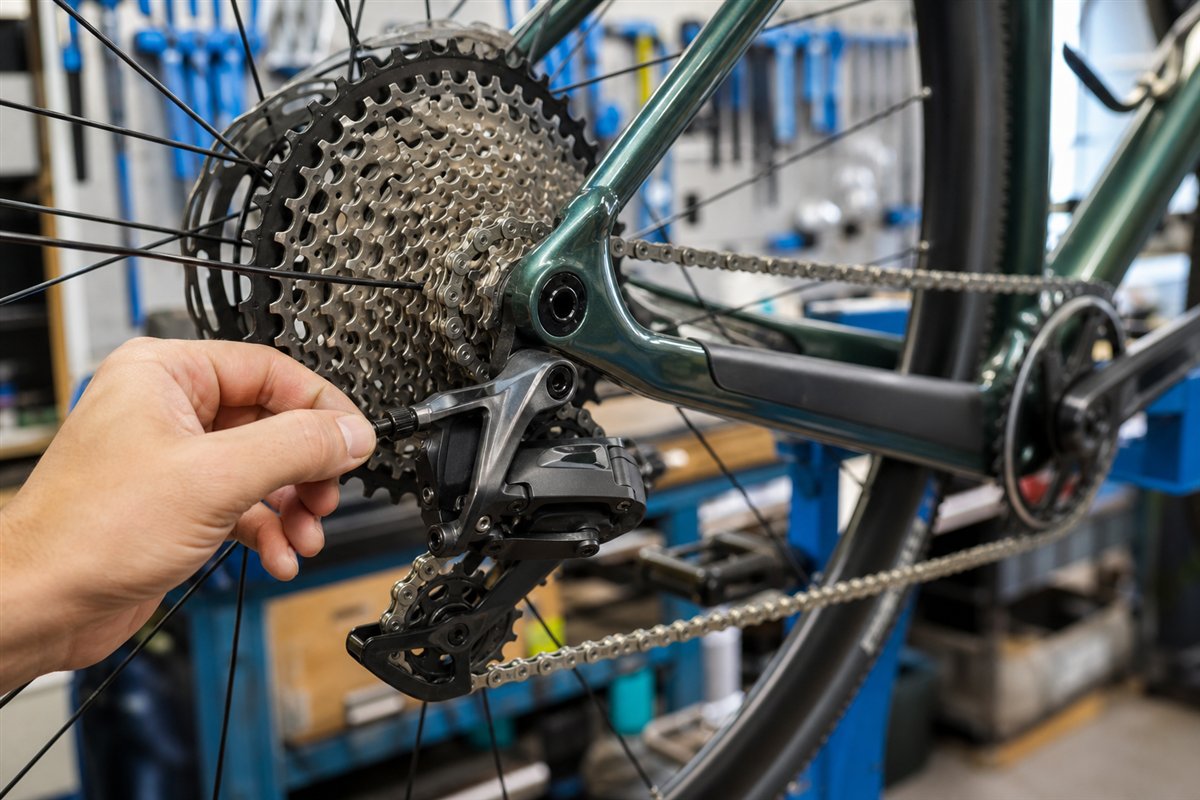
Indexing, by contrast, is a genuine adjustment. When the rear shift cable stretches slightly or the housing settles, the derailleur no longer positions the chain exactly under each cog. The chain then sits half a step off and clatters. A quarter-turn of the rear barrel adjuster, done while pedaling in a stand, usually restores silence. The video below walks through isolating and curing several of these noises in sequence.
A step-by-step diagnostic order
Working in order matters because the cheap, common causes sit at the top, and each step rules out a category so you are not chasing several possibilities at once. Do not skip ahead to derailleur screws before you have cleaned the chain.
-
Wipe and inspect the chain. Hold a clean rag around the chain and backpedal several revolutions. If the rag comes away black and gritty, or the chain looks dry and dull, you have likely found the cause. While you wipe, watch each link pass through your fingers and over the derailleur pulleys, looking for a link that hesitates, kinks sideways, or has a bent plate or protruding pin.
-
Check chain routing. Confirm the chain runs correctly through both derailleur pulleys and has not jumped outside a cage tab. A misrouted chain rattles and can damage the derailleur.
-
Isolate the timing. Turn the cranks slowly and decide: is the noise once per crank revolution (a link), tied to every stroke (chain condition), or only in some gears (adjustment)? This single observation directs the rest of the work.
-
Clean and lubricate if warranted. If the chain is dirty or dry, clean it and apply a suitable lube one link at a time, then wipe off the excess. Do this before any adjustment. See how often to lube a bike chain for products and intervals.
-
Re-test across the gears. With a clean, lubed chain, shift through the range in the stand. Noise that is now gone was lubrication. Noise that remains, and that changes with gear selection, is indexing or alignment.
-
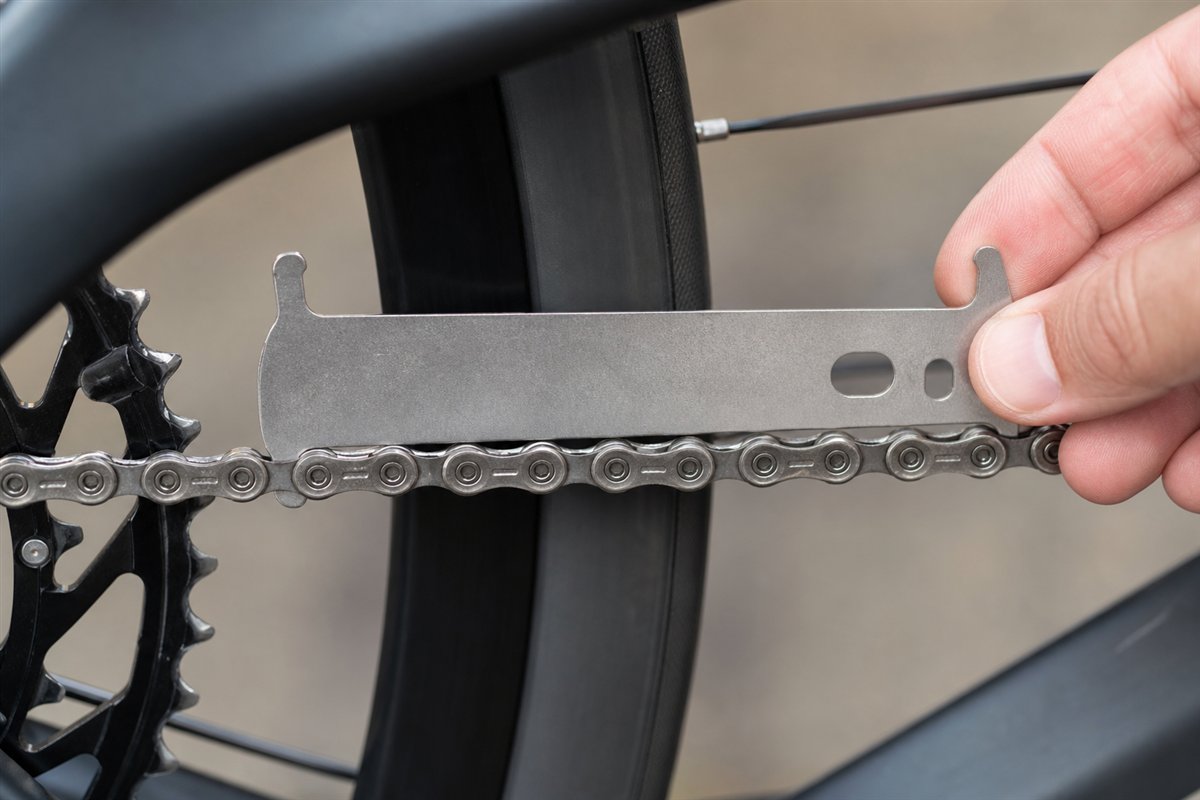
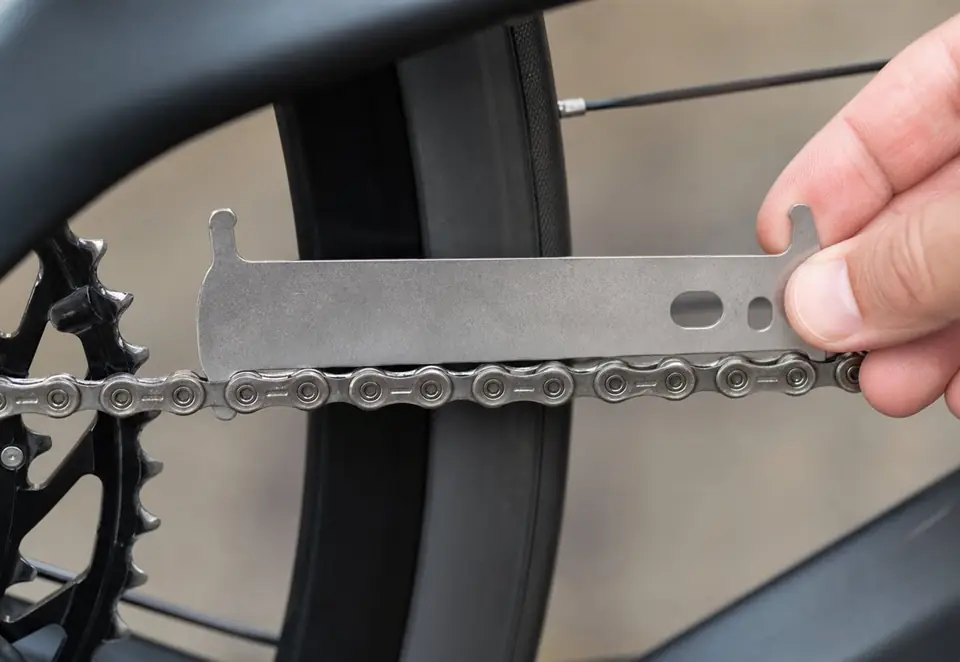
Measure chain wear. If a grinding or skipping persists, measure with a chain-wear gauge before doing anything else. A worn chain will not run quietly no matter how you adjust it, and it damages the cassette if left in service.
-
Check indexing and derailleur alignment. Only after the chain is clean, sound, and within wear limits should you fine-tune the barrel adjuster or inspect the derailleur hanger. Turning adjustment screws to mask a worn-chain noise buries the real problem.
How to fix each cause
Clean and lubricate a dry or dirty chain
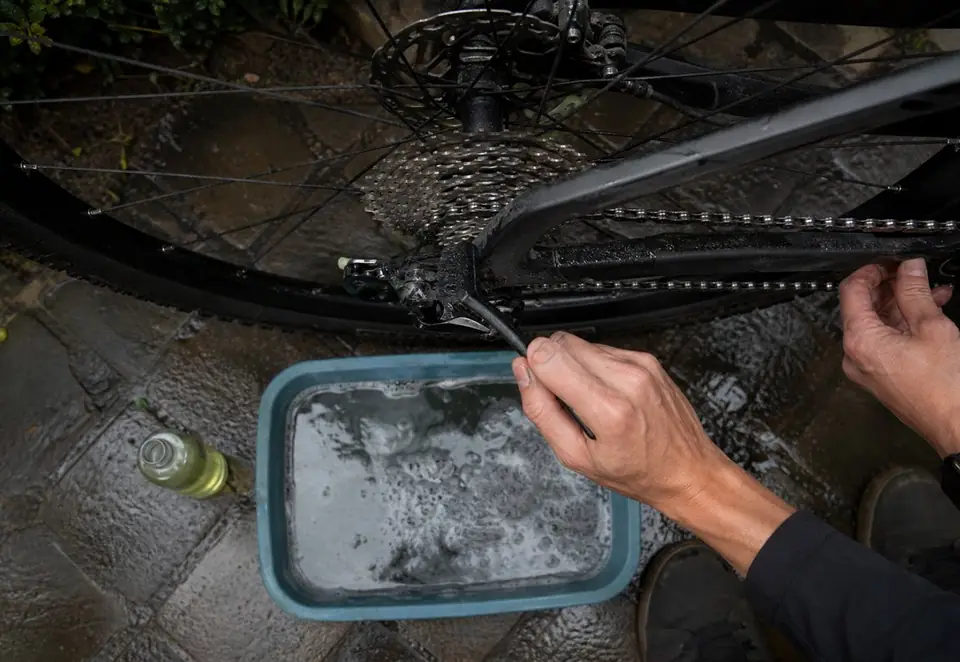
For most noisy chains this is the whole fix. Degrease or wipe the chain until the rag stays reasonably clean, dry it, then apply a lubricant matched to your conditions (dry lube for dry climates, wet lube for rain and mud) one drop per roller. Backpedal to work it in, wait a few minutes, then wipe off everything on the outside of the chain. Excess lube on the surface only attracts the grit that caused the noise in the first place. The full routine is in drivetrain maintenance.
Free a stiff link
A stiff link resists bending and clicks once per revolution. Locate it by backpedaling slowly and watching for the link that jumps as it leaves the lower pulley. Flex that link gently sideways with your thumbs, a few degrees each way, to break loose the dried lube or light corrosion binding the plates. Add a drop of lube and work it. If the stiffness comes from a bent plate, a twisted link, or a protruding pin rather than dry grit, the link is damaged: replace it or take the bike in, because a damaged link can fail under load.
Index the gears
If noise appears in specific gears, adjust the rear derailleur indexing. In a stand, shift to a middle gear and pedal. If the chain hesitates to climb to a larger cog or is noisy there, turn the barrel adjuster counter-clockwise a quarter-turn at a time. If it is noisy shifting toward the smaller cogs, turn it clockwise. Make small changes and re-test after each. If no adjuster position quiets the whole range, suspect a bent hanger or a worn cable.
Stop cross-chain and derailleur rub
For rub in the extreme gears, first try the front derailleur trim if your shifter has one. The lasting fix is habit: shift the front chainring so the chain runs straighter. If the front derailleur rubs across many gears rather than only the extremes, its cage height or angle is off and needs setting.
Replace a worn chain
If the gauge shows the chain has reached its wear limit, replace it. A worn chain is noisy, shifts poorly, and grinds down the cassette teeth. Left too long, it wears the cassette to match, so a fresh chain then skips on the old cogs and you must replace both. Measuring and replacing on time is the cheapest path; see checking chain wear for the thresholds.
When it is not the chain
A large share of “chain noise” complaints are not the chain at all. The drivetrain is central and metallic, so it broadcasts noise made elsewhere. Rule these out before you spend more time on the chain:
- Freehub and rear hub. A tick or click while coasting, when you are not pedaling, is not the chain. The freehub ratchet clicks by design; an irregular tick can be a hub issue.
- Pedals and cleats. Dry pedal bearings or a loose cleat produce a rhythmic click that seems to come from the crank area. Swapping shoes or greasing the cleat bolts often reveals it.
- Bottom bracket and crank. A creak or clunk that appears mainly when you stand and push hard, felt through both pedals, usually comes from the bottom bracket, crank bolts, or chainring bolts, not the chain.
- Seatpost and saddle. A creak in time with pedaling but coming from behind you is often the seatpost clamp or saddle rails, transmitted forward through the frame.
- Brakes. A rub that tracks with wheel rotation rather than pedaling is a pad or rotor touching, not the drivetrain.
The trick to isolating these is to change one variable at a time: coast to remove the chain, stand versus sit to load the bottom bracket, pedal with one foot to test each pedal, or lift and spin each wheel. If the noise disappears when you coast but returns the instant you pedal, it is drivetrain-related; if it stays while coasting, look outside the drivetrain first. The GCN video above demonstrates several of these isolation tests, and the same one-variable discipline is what separates a ten-minute fix from an afternoon of guessing.
When to see a mechanic
Home diagnosis handles most chain noise, but some situations warrant a professional or an immediate stop.
Stop riding now if you find a cracked or bent chain plate, a pin pushing out of a link, severe rust that stiffens the chain, or a chain that skips forward under pedaling load. These can fail suddenly and drop you onto the top tube.
Book a mechanic if the noise persists after you have cleaned and lubed the chain, confirmed it is within wear limits, and made small indexing adjustments without success. That pattern points to a bent derailleur hanger, a worn cassette, a damaged derailleur, or an internal bottom-bracket or hub issue, none of which should be fixed by turning screws at random. A hanger that is even slightly bent throws off every gear and cannot be judged reliably by eye; a shop has the alignment gauge to check it.
Diagnosing a bike chain making noise is mostly a matter of patience and order: listen for when it happens, match the sound, clean first, measure wear, then adjust. Skip the temptation to drown every sound in lubricant. A chain that stays quiet is one that is clean, sound, correctly adjusted, and replaced before it wears out.
Frequently asked questions
Why does my bike chain make noise when pedaling?
A chain that is noisy under pedaling is usually dry or dirty, but it can also be worn, misaligned in a cross-chained gear, or rubbing the front derailleur. Diagnose in that order before simply adding more lubricant.
Why is my bike chain clicking?
A rhythmic click once per pedal revolution often means a stiff or damaged link, while a click tied to one specific gear usually means the derailleur needs indexing. A gritty grinding noise points to a dry or worn chain.
How do I stop my bike chain from making noise?
Clean and re-lube the chain first, then check indexing and derailleur alignment, inspect for a stiff link, and measure chain wear. Noise that persists after lubrication points to adjustment or wear, not lubrication.
Why does my bike only make noise in certain gears?
Noise limited to a few gears usually means indexing is slightly off, the chain is cross-chained at an extreme angle, or one cassette sprocket is worn or damaged. Noise in every gear instead points to a dry, dirty, or worn chain, or a derailleur that rubs across the whole range.
Continue the topic
More drivetrain care guides
 Bike Chain Skipping Under Load: Likely Causes
 Bike Chain Wear: How to Check It Correctly
 Bike Drivetrain Maintenance: A Practical Routine
Watch the technique
How To Clean, Degrease and Lube a Bike Chain
Video by RJ The Bike Guy · Watch on YouTube